 Pressmediaofindia

Related Articles


09-05-2026
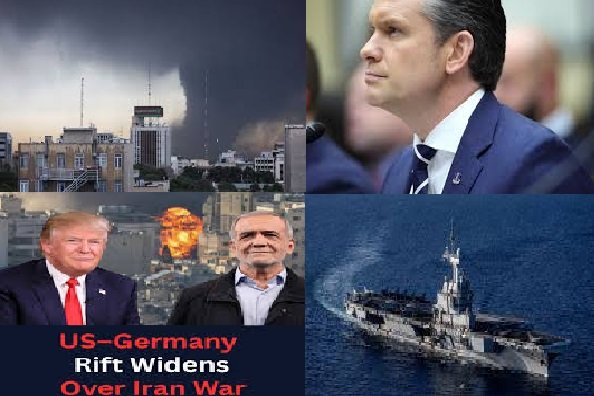
BERLIN: A diplomatic rift between US President Donald Trump and German Chancellor Friedrich Merz over the war on Iran has escalated into a broader debate about Europe’s transatlantic ties while Berlin pushes to become the continent’s leading military power.
 Merz sparked controversy last week when he said Washington had been “humiliated” by its failure to reach a deal with Tehran and accused Trump of having “no strategy.”
The remarks triggered a heated discussion that has intensified since Trump announced the redeployment of 5,000 US troops from German soil.
According to media reports, the withdrawal will include a Stryker Brigade currently stationed in Vilseck, Bavaria, a redeployment that had first been mentioned by Trump in 2020.
The announcement comes as Germany dispatched a minesweeper and a replenishment vessel to the Mediterranean on Monday, bound for the Strait of Hormuz. While Berlin has said the vessels would only take part in operations to clear the narrow shipping lane after hostilities ended, the United States has relied heavily on bases and military infrastructure across Germany throughout its campaign in Iran.
Merz, a former senior adviser at BlackRock who has long been seen as closely aligned with US interests said the troop withdrawal came as no surprise. The defence ministry described the move as “foreseeable”.
Republican politicians Roger Wicker and Mike Rogers, chairs of the Senate and House Armed Services Committees, expressed “grave concern” over the withdrawal.
The move would return troop numbers roughly to levels last seen before Russia’s full-scale invasion of Ukraine in 2022, meaning the operational impact may be limited. More consequential, analysts say, could be a separate decision to cancel plans to station long-range weapons systems in Germany.
On Monday, the German defence ministry said there had been no “definitive cancellation” by the US of a plan to deploy a battalion with long-range Tomahawk cruise missiles and SM-6 missiles to Germany.
 A spokesperson of the Chancellor’s Office said on the matter, “It is important to implement the development of our own systems in Europe and Germany.”
The US had planned episodic deployments of long-range fires capabilities in Germany from 2026. Due to their long range, these missiles can strike targets deep inside Russia. With some 36,000 troops currently stationed on its soil, Germany is home to one of the largest US deployments abroad.
During the Cold War, Germany served as NATO’s front line against Soviet expansion. Until today, its bases are considered essential to US operations across the Middle East, clustered in the country’s south and southwest.
The most prominent is Ramstein, the US’s largest installation in Europe, which serves as a military hub for drone operations, from where transmission of data and video signals via satellite and fiber optics enables pilots in the US to carry out strikes. It also functions as a global transit hub for troops and military equipment, situated close to the Landstuhl Regional Medical Center, where wounded US personnel were treated during the Iran war. Stuttgart hosts the US European Command and US Africa Command headquarters, as well as those of US Marine Forces Europe and Africa. According to media reports, facilities close to Stuttgart have also been used to transmit coded communications to Iran, believed to be intended for intelligence operatives on the ground. Additionally, about 20 US nuclear weapons are stationed in Germany, a presence some critics want removed, while others consider it a cornerstone of NATO deterrence. (Int’l Monitoring Desk)