 Pressmediaofindia
Related Articles



04-05-2026
BEIJING: China will scrap tariffs for all African countries from Friday except Eswatini, which maintains ties with Taiwan.
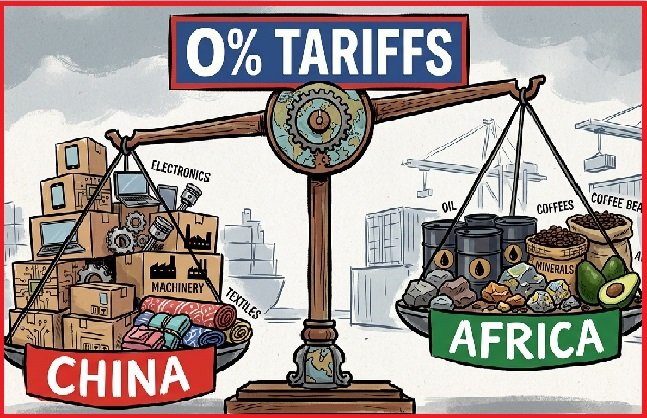 As of December 2024, China had already implemented a duty-free policy for 33 least-developed African nations. The policy now covers 53 countries, and will be in place until 30 April 2028. It is unclear what will happen after that.
Beijing has boasted that it is the first major economy to offer unilateral zero-tariff treatment to Africa but analysts say that while China is seizing the chance to enhance its soft power, they point out that tariffs are rarely the main obstacle for exporters in Africa which has a huge trade deficit with China.
A huge imbalance
“China is positioning itself as the trade liberalizer and Africa-friendly economic partner, in contrast to Donald Trump and the US,” says Lauren Johnston, a senior research fellow at the AustChina Institute.
The US had hit some African nations with tariffs of up to 30% in August, although most are now subject to a 10% tariff, after the US Supreme Court struck down many of the duties. The expansion of China’s zero-tariff regime could increase African agricultural exports, which will “help to elevate rural incomes, improve rural productivity, and ultimately to reduce hunger and poverty”, Johnston says but Sino-African trade is marked by a growing imbalance in China’s favor, which means Chinese exports to Africa far exceed African exports to China and that difference is widening.
Last year, Africa’s trade deficit with China rose by 65% to about $102bn.
Africa’s exports to China are dominated by minerals and raw materials, such as crude oil and metallic ores.
Currently, China’s main trading partners in the region include Angola, driven primarily by oil, the Democratic Republic of Congo, and South Africa.
 However, a consistent duty-free regime across such a heterogenous continent could result in uneven gains, Johnston notes.
More developed, industrialized economies like South Africa and Morocco will be better positioned to expand exports, she says.
On its own, the zero-tariff policy does not address continent-wide needs for economic restructuring and infrastructure upgrading, adds Jervin Naidoo, a political analyst at Oxford Economics Africa.
“Many African economies still face structural constraints, such as limited industrial capacity, weak logistics and a reliance on raw commodity exports, which tariff reductions alone cannot address,” he says.
Alfred Schipke, director of the East Asian Institute in Singapore, agrees that short-term economic impact “will likely be modest and concentrated in African countries that already have export capacity”.
“Over the long term, however, the potential could be more meaningful, especially if African countries are able to expand production, diversify exports, and move up the value chain,” Schipke says.
Amit Jain, another Singapore-based expert in China-Africa relations, notes that changing consumer demand in China could open up new markets for African producers. For instance, Chinese consumers are buying far more coffee and nuts than they did 20 years ago.
“These new measures will improve access to Chinese markets, closing that trade deficit and expand opportunities for African companies to prosper,” he told media.
“For Kenya, it will be a big boost to certain subsectors such as avocado. The agriculture sector will benefit the most macadamia nuts, coffee, tea and leather.” (Int’l Monitoring Desk)