 Pressmediaofindia

Related Articles



20-07-2026
JERUSALEM: Israel’s parliament has officially dissolved, kicking off a high-stakes campaign for national elections on October 27.
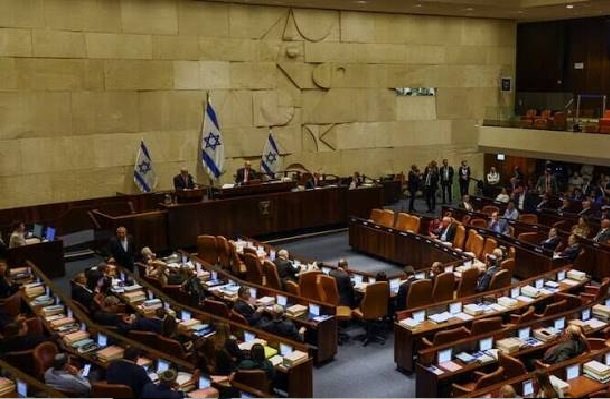 The dissolution of the 25th Knesset (parliament) on Friday paves the way for a vote that is seen as a critical referendum on Prime Minister Benjamin Netanyahu’s political survival and his wars on Gaza, Lebanon and Iran.
It is a rare historical milestone, marking the first time since 1988 that a Knesset has completed its legally mandated, full four-year term.
Due to Israel’s highly volatile political system, fragile coalition governments regularly collapse early, leading to snap elections.
To prepare for the dissolution, the parliament held a final marathon overnight voting session.
Among the legislation passed, according to state broadcaster Kan, was the Party Funding Law, which unlocks the state-regulated funds that political parties need to run their campaigns. This confirmed the October 27 election date in legal terms.
Before adjourning into recess, Netanyahu’s hardline coalition, the most nationalist in Israel’s history, also pushed through a series of controversial laws to secure its base.
The “legislative blitz” included a sweeping Communications Law (passed 53-48), which dismantles independent media regulators in favor of a government-supervised broadcast authority.
Highly divisive legislation shielding ultra-Orthodox men from military conscription was also approved.
Kan noted that these moves were aimed at satisfying Netanyahu’s religious and nationalist coalition partners, protecting the government from fracturing before the campaign begins.
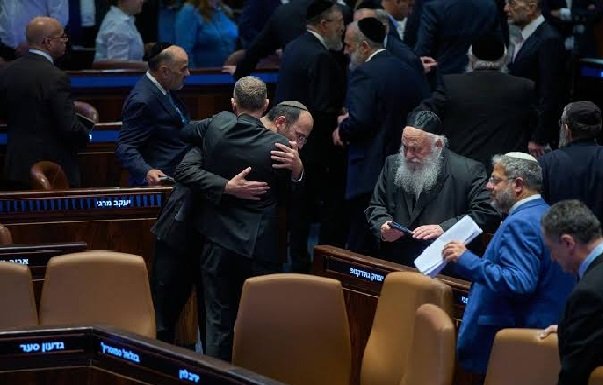 However, Netanyahu and his allies face an uphill battle to survive amid public anger at the unpopular war against Iran.
A Kan poll suggested that the governing Likud party trails the opposition, and that Netanyahu’s bloc remains well short of the 61-seat majority needed to govern.
The primary threat comes from the newly founded, centrist Yashar “Straight” party led by former military chief Gadi Eisenkot which has surged past Likud in recent polling. Following the Knesset’s closure, secular right-wing leader Avigdor Liberman declared on social media: “On October 27, we will win. We will replace the government… and rebuild the country.”
Meanwhile, Israel’s far-right Naftali Bennett and centrist opposition leader Yair Lapid have announced that they will resume the alliance that last toppled Benjamin Netanyahu’s government in 2021, which at the time ended the latter’s 12-year hold on the country’s leadership.
Speaking in Herzliya on Sunday, both former prime ministers addressed the waiting press pack from identical podiums, with Bennett telling reporters, “Tonight, we are uniting and establishing the ‘Together’ party under my leadership, a party that will lead to a great victory, and the opening of a new era for our beloved country” but, according to a poll published by the Jerusalem Post on Monday, the new bloc is projected to win four fewer seats than the combined total of both politicians’ former parties if they were running separately, and would have one seat fewer than Netanyahu’s Likud Party.
And while a significant proportion of Israelis are opposed to Netanyahu, the Bennett-Lapid alliance is not new, and has its own opponents. When the two opposition figures last joined forces in 2021 and won the election, they formed an unusually broad coalition spanning right-wing, centre, and left-wing parties, as well as for the first time in Israeli government, a party representing Palestinian citizens of Israel. (Int’l News Desk)