 Pressmediaofindia

Related Articles



17-06-2026
Bureau Report
NEW DELHI: With a smartphone strapped to her head, Indian housewife Nagireddy Sriramyachandra films herself slicing mangoes to train artificial intelligence-powered robots to take on household tasks in the future.
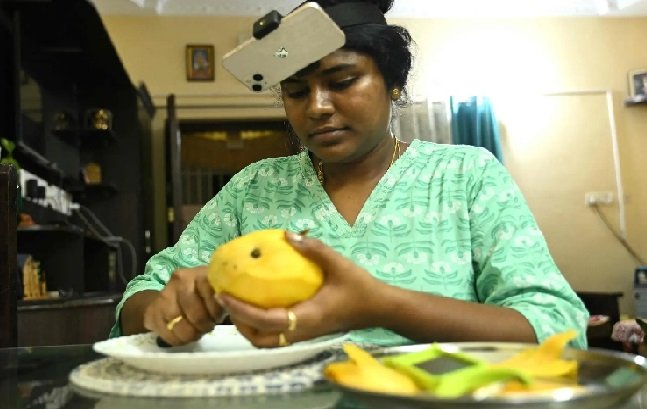 Earning 250 rupees ($2.6) for one hour of video, her mundane recordings are invaluable for global tech companies teaching machines how to move like humans in the real world.
The 25-year-old is one of a growing army of thousands of AI system trainers in the world’s most populous country.
“Who else will give you 250 rupees an hour just for doing housework?” asked Sriramyachandra from her kitchen in Chennai, the capital city of the southern Indian state of Tamil Nadu.
“I may get a robot myself in the future,” she added.
AI chatbots and image generators crunch vast amounts of digital data, but building systems to navigate real-life environments is more challenging. Developers believe that feeding first-person footage, known as egocentric data, into specialised AI models will help robots copy human behaviour.
Some AI trainers work at home, others in factories or specialized studios using video glasses, head-mounted cameras and motion sensors.
“It blares ‘hands not detected’ when I’m not recording properly,” said Sriramyachandra, who sends recordings via a special app to an AI data company, which has offices in India and the United States and lists Fortune 500 multinationals among its clients.
The humanoid robot market is booming, and as per projections, more than one billion will be in use by 2050, mostly for industrial and commercial purposes. India has positioned itself as a global middleman for the creation, processing and annotation of AI data.
“It’s likely that these data collection services will increase,” said digital labor expert Aditi Surie, from the Indian Institute for Human Settlements in Bengaluru, the southern city known as India’s Silicon Valley.
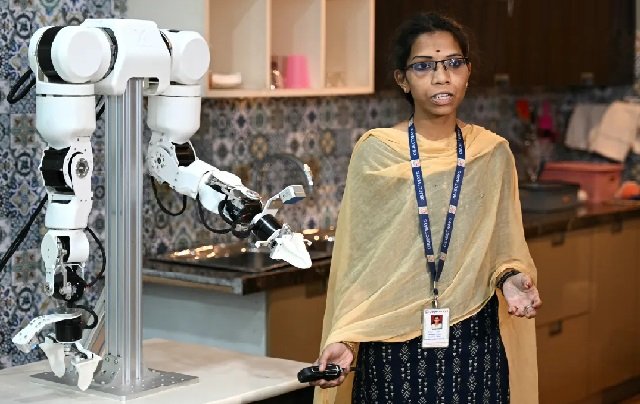 Alongside the technology’s much-hyped benefits, automation also poses risks.
Government think tank NITI Aayog said most discussions around AI and labor “focus on white-collar professionals and predict an almost certain loss of jobs in the segment” without urgent action.
“Little attention, if any, is paid to how AI can serve India’s 490 million informal workers, the very people who form the backbone of our economy,” it said in a report released in the run-up to a global AI summit in India this year.
For the last decade, 55-year-old Ponni has sat by the roadside in Bengaluru, making flower garlands. She, too, has been paid to have a phone strapped to her forehead.
“The next generation … who might have to do work similar to mine, they will face a problem,” Ponni said.
However, Tech giants are racing to build the infrastructure that powers artificial intelligence but a growing body of evidence suggests that AI hyperscalers large-scale cloud service providers like Google, Amazon and Microsoft are warming the ground around them as well.
A study by Cambridge-led researchers found that land surface temperatures around AI data centers rise by an average of 2 degrees Celsius (3.6 degrees Fahrenheit), with some areas recording increases as high as 9C (16.2F).
Researchers have called this the “data heat island effect”. Media explains what that is, where AI data centers are concentrated and the effects on those living near these facilities.