 Pressmediaofindia

Related Articles



12-06-2026
Bureau Report
NEW DELHI: India’s fertility rate has for the first time fallen below the level needed to stop the population from shrinking, raising concerns about future labour shortages and an ageing society.
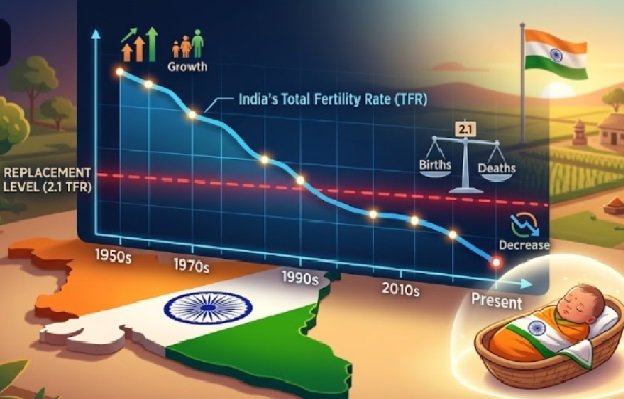 For decades, India has seen rapid population growth. According to government statistics, including the Sample Registration System (SRS) Statistical Report, the country’s largest demographic survey, India has had a falling fertility rate for some years but the reproduction rate remained high enough to keep the population growing.
The latest SRS report, released last month by India’s Office of the Registrar General and Census Commissioner, said that India’s Total Fertility Rate (TFR) had dropped to 1.9 children per woman lower than the benchmark level of 2.1 needed to keep the population stable in the long run. TFR is the average number of children that a woman is expected to have in her lifetime. In the 2000s, India’s TFR was around 3.3 births per woman.
So, what is behind reduced fertility? Why does it matter and what are the consequences?
For decades starting in the 1970s, Indian governments and policymakers have tried to battle what they argued was overpopulation too many people and too few resources to manage for what was then a relatively poor nation.
Many top-down government initiatives including a brief controversial effort to forcibly sterilize people in the 1970s aimed to control India’s population.
Despite that, by 2019, India’s Prime Minister Narendra Modi was still warning of a “population explosion” but by 2022, the first signs that India was about to tip over into uncharted territory: The National Family Health Survey released data suggesting that India’s TFR was falling fast, across communities. Yet a year later, India surpassed China to become the world’s most populous nation and the trend of a declining fertility rate was swamped by the headlines of a 1.5 billion population.
Now, latest survey suggests that the prospect of a shrinking population might be more imminent than policymakers had planned for.
 Experts say better access to education and contraceptives are among key factors behind the falling fertility rate along with the increased costs of bringing up children.
“Total fertility rate often drops when more women in society have access to education, contraceptives and more agency in decision-making in households”, Dipa Sinha, a development economist who works on social policy in India, told media. “It also drops when the economy becomes expensive so raising children also becomes expensive.” She said there’s another reason too.
As infant mortality reduces, the desire to have more children also decreases. According to the latest SRS report, India has recorded a significant decline in infant deaths from 30 per 1,000 live births in 2019 to 24 deaths per 1,000 live births in 2024. These factors also correlate almost perfectly with the differential levels of fertility rates across the country.
According to the May demographic survey report, India’s poorest states, such as Bihar in northern India with the lowest levels of education and high infant mortality rates, also recorded the highest fertility rate in the country at 2.9, followed by 2.6 in Uttar Pradesh.
By contrast, India’s capital New Delhi with among the highest levels of education and lowest infant mortality rates registered the lowest fertility rate, with an average of 1.2 births per woman. Southern states such as Tamil Nadu and Kerala, with among the best health and education systems in India, recorded a rate of 1.3.