 Pressmediaofindia
Related Articles



08-06-2026
Bureau Report
NEW DELHI: Are electric vehicles finally going mainstream in India? A slew of indicators suggests the transition may finally be gathering momentum.
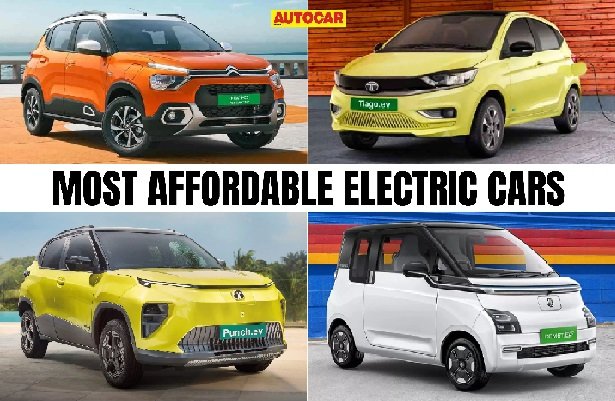 The market for electric cars expanded by a solid 25% in the year ending March 2026, while EVs crossed the important 5% threshold in India’s passenger vehicle market earlier this year, a figure often seen as a tipping point for mass-market adoption.
“The transition is no longer directional but substantive,” India’s automobile dealers association said in a press note recently.
Adoption is accelerating particularly in larger cars priced above one million rupees ($10,481; £7,777), where one in every 10 vehicles sold is now electric. Electric three-wheelers and motorbikes already account for more than 30% and 15% of sales in their respective categories.
Interest in electric cars has spiked sharply in the last few months, particularly against the backdrop of the Middle East conflict.
India imports nearly 90% of its oil, and state-run fuel retailers have been forced to raise pump prices after keeping them relatively stable for four years, as crude prices jumped by 50%.
Prime Minister Narendra Modi has also urged Indians to car pool, use public transport and work from home to conserve fuel.
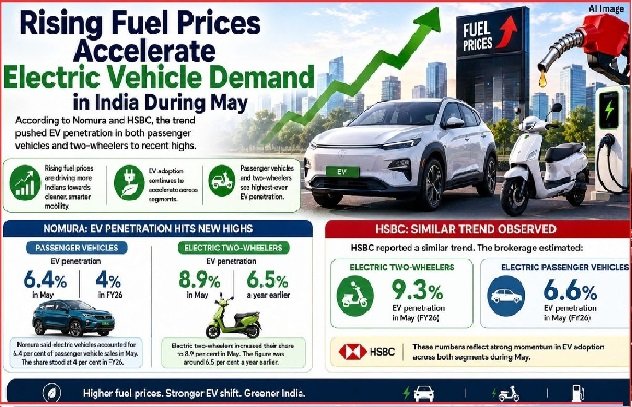
“This rising uncertainty, alongside elevated fuel prices, acts as an incremental driver strengthening the case for EVs,” says Nomura, the Japanese brokerage but beyond these immediate triggers, several longer-term factors are also driving buyer interest, most notably upcoming regulatory norms, known as CAFE-3, which are scheduled to come into force from April next year and run until March 2032.
These “meaningfully tighten regulation and are likely to drive more visible acceleration in EV adoption”, Venugopal Garre and Param Shah, analysts with Bernstein, said in a note.
India currently doesn’t pair its EV incentives with stringent targets or penalties, something CAFE-3 will make binding, say Garre and Shah.
The draft rules seek to reduce carbon emissions in cars from 113 to 76g/km by 2032, a 33% drop.
 Moreover, unlike in the present scenario where “penalties of about a billion dollars in fines across eight OEMs (original equipment manufacturers) were never collected, CAFE-3 penalties might be”, according to Bernstein, all of which will push the case for EVs.
Individual city-states like Delhi, one of the country’s most polluted hotspots have also recently released ambitious draft policies that propose to phase out conventional internal combustion engines and halt registrations of new ICE two and three wheelers by 2027. Another tailwind will be a “healthy launch pipeline”, says Nomura, which expects EV penetration in India’s passenger vehicle market to reach 9% by 2030.
In the two-wheeler segment too, demand is expected to be driven by a wave of new affordable models, while EV three-wheelers are projected to outsell non-EV variants by 2030, accelerating the transition.
“India’s transition is more concentrated in high-utilization, cost-sensitive categories such as three-wheelers, suggesting that the adoption curve is likely to be non-linear, with PV and two-wheeler penetration accelerating over time as affordability improves, charging infrastructure expands, and policy support strengthens,” Nomura says. Yet, despite these encouraging signs, India lags behind major global economies in EV adoption.