 Pressmediaofindia
Related Articles



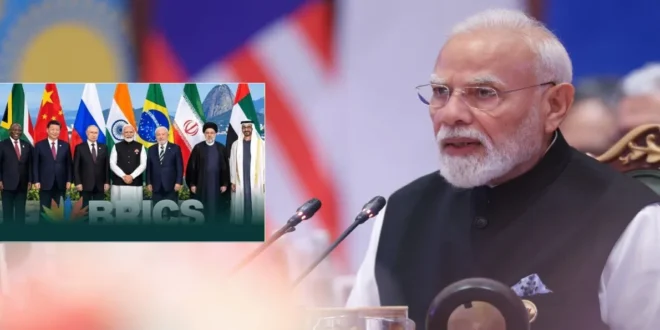
New Delhi, Sept. 12: The 18th BRICS Summit unanimously adopted the New Delhi Declaration 2026, outlining a common position on a wide range of global issues, including international peace and security, the escalating situation in West Asia, the Gaza conflict, the April 22, 2025 terrorist attack in Jammu and Kashmir, the fight against terrorism, reforms in the United Nations and global financial institutions, greater representation for the Global South, nuclear disarmament and non-proliferation, global trade and supply chains, unilateral tariffs and economic sanctions, cross-border payments, and the use of local currencies for trade and investment.
The declaration called for restraint by all parties amid rising tensions in West Asia and stressed the need to resolve conflicts through dialogue, consultation and diplomacy. It also emphasised the protection of civilians and civilian infrastructure, respect for sovereignty and territorial integrity, and the uninterrupted flow of trade and energy in accordance with international law.
On Gaza, the BRICS countries called for the implementation of relevant United Nations resolutions, the continuation of the ceasefire and full, safe and unhindered humanitarian access to the Gaza Strip. The declaration expressed concern over continuing violence and opposed any policy aimed at the forced displacement of Palestinians. It stressed that a just and lasting solution to the Israel-Palestine conflict should be achieved through peaceful means while recognising the legitimate rights of the Palestinian people, including the right to self-determination and return.
The BRICS countries strongly condemned the terrorist attack in Jammu and Kashmir on April 22, 2025, in which 26 people were killed and several others injured. They reiterated their commitment to combating terrorism in all its forms and manifestations and called for action against cross-border movement of terrorists, terrorist financing and the provision of safe havens to terrorists.
The declaration reaffirmed a zero-tolerance approach to terrorism and rejected double standards in dealing with terrorist activities. It also called for the early finalisation and adoption of the Comprehensive Convention on International Terrorism under the United Nations and urged coordinated action against all terrorists and terrorist organisations designated by the UN.
UN reforms and stronger voice for Global South
The BRICS countries supported comprehensive reform of the United Nations, particularly the Security Council, with the objective of making it more representative, democratic, effective and responsive to contemporary global realities.
The declaration called for greater representation of developing countries in global decision-making institutions and supported a stronger role for the Global South. China and Russia reiterated their support for a greater role for India and Brazil in the United Nations and the Security Council.
BRICS also backed the legitimate aspirations of African countries for greater representation in the Security Council and stressed the need for broader participation by developing countries from Africa, Asia, Latin America and the Caribbean in global decision-making.
The declaration also highlighted the need to increase women’s representation in international institutions, particularly women from developing countries, and drew attention to the issue of gender and regional representation in the selection of future UN leadership.
Reforms in global economic system
The declaration called for reforms in the global economic and financial system to reflect the growing contribution of emerging markets and developing economies to global production and growth.
BRICS supported reforms in the Bretton Woods institutions, including the International Monetary Fund and World Bank, to provide developing countries with greater representation and participation in their governance in line with their growing economic importance.
The BRICS countries also supported reforms in the World Trade Organization and reaffirmed their commitment to an open, fair, transparent, inclusive, predictable and rules-based multilateral trading system.
The declaration expressed serious concern over the growing use of unilateral tariffs and non-tariff measures, saying such steps could disrupt international trade, create risks for global supply chains and increase uncertainty in the world economy. It also expressed opposition to unilateral economic and secondary sanctions that are inconsistent with international law.
Easier cross-border payments
The New Delhi Declaration called for practical solutions to make cross-border payments among BRICS countries faster, cheaper, easier and more secure.
The BRICS Payments Task Force was encouraged to continue its work on cross-border payment mechanisms based on initiatives contained in earlier Kazan and Rio declarations. The countries also discussed the possibility of greater interoperability between different national payment and financial messaging systems.
The declaration supported efforts to promote settlements for trade and investment in local currencies, while emphasising that national priorities of individual member countries should be respected and that no single mechanism should be imposed on all members.
Trade, investment and supply chains
The BRICS countries supported measures to strengthen trade and investment among member states by making global value chains more stable and predictable, digitising trade-related documentation and improving connectivity.
The declaration welcomed initiatives aimed at improving access to finance for small and medium-sized enterprises and enabling them to participate more actively in international trade.
BRICS also supported continued technical work on investment platforms and cooperation in financial and settlement infrastructure, along with measures to strengthen insurance and reinsurance capacities.
Nuclear disarmament and security
The declaration expressed concern over rising nuclear risks, the possibility of further conflicts and the continued increase in global military expenditure.
BRICS reaffirmed the importance of nuclear disarmament, arms control and strengthening the international nuclear non-proliferation regime. The member states also recognised the importance of nuclear-weapon-free zones and reiterated support for efforts to establish a Middle East free of nuclear weapons and other weapons of mass destruction.
The countries stressed that peaceful nuclear facilities operating under the safeguards of the International Atomic Energy Agency must remain protected even during armed conflicts, in order to safeguard human life and the environment.
BRICS cooperation
The declaration reaffirmed the commitment to strengthening cooperation in the three broad areas that have formed the foundation of BRICS cooperation: political and security cooperation, economic and financial cooperation, and cultural and people-to-people exchanges.
The member countries welcomed the progress achieved under India’s 2026 BRICS chairship and reiterated their commitment to promoting peace, development, sustainability, innovation and cooperation.
The declaration also emphasised the importance of giving the Global South a stronger voice in international affairs and working towards a fairer, more inclusive, representative, stable and rules-based international system capable of addressing emerging global challenges.