 Pressmediaofindia
Related Articles



04-05-2026
ATHENS: When the conservative New Democracy party came to power in Greece in 2019, it promised a work-driven economy that would grow by 4 percent a year and elevate living standards after a decade of austerity.
 In an appeal to the productive, non-state economy, Kyriakos Mitsotakis became prime minister, asking Greeks to “work together to build a new compact of trust based on meritocracy, industriousness, security, justice, opportunities for everyone”.
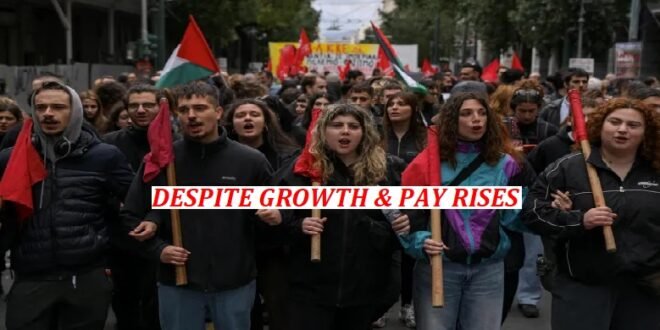
Five years later, Greeks had the second-lowest annual salaries in the European Union after Bulgaria, according to Eurostat, the EU statistical agency.
Every other Eastern European country that had become a free-market democracy in 1991 and an EU member in 2004, almost a quarter-century after Greece, has leapfrogged ahead of it.
From 2019 to 2024, “Bulgaria rose 11 points whereas we rose 3 points,” said Yiorgos Christopoulos, spokesman for the General Confederation of Workers in Greece (GSEE), the country’s private sector umbrella union. “If this goes on, Bulgaria, too, will overtake us in the next two to three years,” he told media.
GSEE’s latest report found that during these five years, Greek living standards rose from 65.5 percent of the EU average to just 68.5 percent, despite the fact that the economy has grown at almost twice the EU rate since the COVID-19 pandemic in 2020.
What went wrong?
When New Democracy was re-elected in 2023, it promised to restore living standards and made good on those promises.
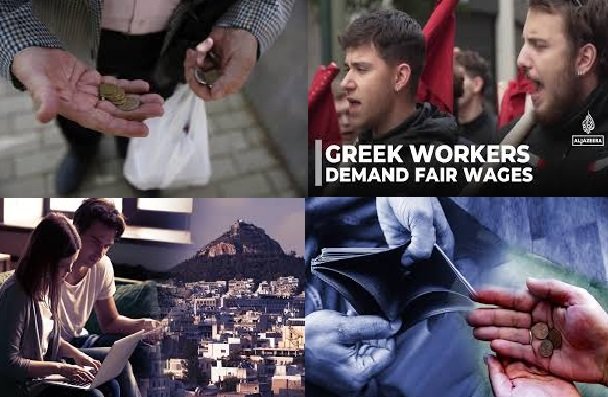
Minimum wage was recently restored to 920 euros ($1,080) a month, from the 580 euros ($680) to which it had been slashed amid the post-2009 global financial crisis. By next year, it is to rise to 950 euros ($1,114).
Average monthly wages, too, have risen to 1,516 euros ($1,777), fulfilling New Democracy’s promise a year early.
 New Democracy also came through on promises of tax cuts. This year, all income tax brackets were slashed by two points, and by a further two points for each dependent child.
Workers under 25 pay no tax until they earn more than 20,000 euros ($23,450).
Mitsotakis took a moment to congratulate his government on its performance since 2019 at last September’s Thessaloniki International Fair, where he announced these measures.
“It’s no coincidence that the country of austerity now has one of the highest growth rates in Europe, with unemployment at 8 percent, down from 18 percent, 500,000 new jobs, public debt 30 points lower, while salaries increase and taxes fall” but in real terms, Greek incomes have fallen by a third in the past 15 years, EU statistics show.
“There’s a greater increase in inflation than in salaries, so we have a fall in purchasing power,” explained Efi Achtsioglou, who was labour minister under the left-wing Syriza government in 2016-19. “In our country, inflation is much higher than the EU average, and our salaries are lower than the EU average in real terms,” she told media.
Normally, labor unions and employers’ unions would sit with the government every year to agree on sectoral wage rises roughly in line with inflation. This has not happened since New Democracy came to power.
“I think what has led to this situation is that you have very few workers now covered by collective wage bargaining agreements below 20 percent, when EU directives say it has to be above 80 percent,” said Achtsioglou. (Int’l Monitoring Desk)