 Pressmediaofindia
Related Articles

DMK and NCP (Sharad Pawar) Signal Support; Political Equations Shift Ahead of Parliament’s Special Session
New Delhi, November 29 (PMI): The Centre has expressed confidence in securing the required parliamentary support for its proposed delimitation-linked Women’s Reservation legislation, claiming that 371 Lok Sabha members are backing the constitutional amendment package ahead of the special sitting of Parliament beginning November 30.
The government’s confidence has increased following significant political realignments, including the decision of the Dravida Munnetra Kazhagam (DMK), led by Tamil Nadu Chief Minister M.K. Stalin, to support the revised legislation despite efforts by opposition INDIA bloc leaders to persuade him to reconsider his position.
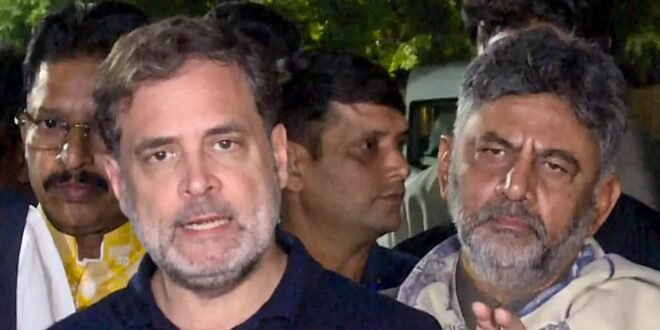
In an unusual political move, a delegation of senior INDIA bloc leaders, including Congress president Mallikarjun Kharge, Sonia Gandhi, Rahul Gandhi and Trinamool Congress chief Mamata Banerjee, travelled to Chennai to meet Stalin and seek his support against the proposed legislation.
However, Stalin made it clear that the DMK would support the revised Bill, arguing that its provisions offered protection to Tamil Nadu’s existing share of parliamentary representation.
The revised proposal reportedly provides for a uniform 50 per cent increase in Lok Sabha seats across states while freezing the proportional distribution of seats until 2051. According to Stalin, the arrangement would protect Tamil Nadu’s current 7.18 per cent share of representation in Parliament.
” If the delimitation Bill is defeated, we will lose even minimal protection to Tamil Nadu. There is no option but to support the Delimitation Bill,” Stalin said, emphasising that his party’s priority was safeguarding the state’s interests.
The DMK has 22 Lok Sabha members, whose support could prove significant in the government’s efforts to secure the required majority.
NCP (Sharad Pawar) Also Signals Support
Another important development has come from the Nationalist Congress Party (Sharadchandra Pawar), which had opposed the earlier version of the legislation in April. The party has now indicated support for the revised formula of uniform expansion of parliamentary seats.
The NCP (SP), which has eight Lok Sabha MPs, had earlier joined the DMK and other opposition parties in defeating the government’s constitutional amendment proposal.
The latest political developments have therefore changed the parliamentary calculations ahead of the special session.
Government Claims Two-Thirds Majority
According to government sources, the proposed legislation has secured the backing of 371 Lok Sabha MPs, comfortably exceeding the two-thirds majority required for passing a constitutional amendment.
The proposed constitutional changes are intended to increase the maximum strength of the Lok Sabha to 850 members, comprising up to 815 representatives from states and 35 from Union Territories.
The legislation also proposes increasing the maximum strength of state Legislative Assemblies from 500 to 650 members.
A senior government functionary said that the number of constituencies reserved for Scheduled Castes (SCs) and Scheduled Tribes (STs) would also increase proportionately by 50 per cent. The proposed women’s reservation would extend to SC- and ST-reserved constituencies as well.
Under the broader framework, 33 per cent of seats in the Lok Sabha and state Legislative Assemblies would be reserved for women.
Modi Holds Meeting with Senior BJP Leaders
Meanwhile, Prime Minister Narendra Modi held a meeting with senior Union Ministers, BJP leaders and Members of Parliament at his official residence, 7 Lok Kalyan Marg, on Sunday evening.
Those present included Defence Minister Rajnath Singh, Home Minister Amit Shah, BJP national president Nitin Nabin, J.P. Nadda and several other senior leaders. More than 30 MPs and ministers, along with BJP general secretary (organisation) B.L. Santhosh, attended the meeting.
Describing the interaction as productive, Modi said in a post on X that discussions covered various subjects during the meeting of the BJP Parliamentary Party Executive Committee.
Earlier, in a video message, the Prime Minister reiterated the BJP and NDA’s commitment to women’s empowerment, stating that the proposed 33 per cent reservation for women in Parliament and state Assemblies was an important national requirement.
He said the government’s commitment to empowering ‘Nari Shakti’ remained firm and that national interest must take precedence over party politics.
“For us, national interest is supreme,” Modi said, urging political parties to support the legislation in the interest of women’s representation and the country’s future.
Rahul Gandhi Raises Concerns Over Delimitation
Following the unsuccessful meeting with Stalin, Congress leader and Leader of Opposition in the Lok Sabha Rahul Gandhi expressed concern over the proposed delimitation exercise.
Gandhi said the opposition delegation had appealed to Stalin to protect Tamil Nadu’s interests and warned that the BJP’s proposed expansion of the Lok Sabha to 850 seats could have far-reaching consequences for the country’s democratic and federal structure.
He alleged that the proposed exercise could adversely affect Tamil Nadu’s political representation, language and cultural identity. He also accused the RSS of being hostile towards Tamil culture.
The BJP, however, rejected the opposition’s criticism, maintaining that the legislation was aimed at strengthening women’s participation in the country’s democratic institutions.
BJP national spokesperson Pradeep Bhandari said India would become the first major economy to provide 33 per cent constitutional reservation to women in Parliament.
Political Numbers Change Since April
The parliamentary arithmetic has undergone considerable changes since the government’s earlier constitutional amendment proposal was defeated on April 17.
During the previous voting, 298 MPs supported the Bill while 230 voted against it. With 528 votes cast, the government required 352 votes but fell short by 54.
Since then, political developments and changes in party alignments have altered the position of several MPs.
According to the figures cited in the report, 20 Trinamool Congress MPs have broken away and merged with the Nationalist Citizens Party of India (NCPI), reportedly pledging support to the NDA. Another six MPs belonging to Shiv Sena (UBT) have joined the Eknath Shinde-led Shiv Sena.
However, the Trinamool Congress has challenged the participation of its rebel MPs in the forthcoming voting.
Party leader Abhishek Banerjee has reportedly written to Lok Sabha Speaker Om Birla, requesting that the 20 rebel MPs not be permitted to participate in the voting, citing pending disqualification proceedings.
The Trinamool Congress has also issued a three-line whip directing all its Lok Sabha MPs to remain present from November 30 to December 4 and follow the party’s position.
The BJP and Congress have similarly issued three-line whips to their respective MPs. The Aam Aadmi Party, which has three Lok Sabha members and opposes the legislation, has also issued a whip.
NDA and Opposition Strength
The NDA is reported to have 299 Lok Sabha MPs, including 240 from the BJP, 16 from the Telugu Desam Party, 13 from the Eknath Shinde-led Shiv Sena and 12 from the Janata Dal (United), besides smaller alliance partners.
The alliance has also received a political boost from the Shiromani Akali Dal’s Harsimrat Kaur Badal, following the revival of the BJP-Akali Dal alliance for the Punjab Assembly elections.
The support indicated by the DMK (22), NCP (Sharad Pawar) (8), NCPI (20) and YSR Congress Party (4) could further strengthen the proposed legislation.
However, the Jharkhand Mukti Morcha, which is part of the INDIA bloc and shares power with Congress in Jharkhand, has yet to clarify its position.
The opposition INDIA bloc’s strength has also reportedly declined since April. Its major constituents include Congress with 98 MPs, Samajwadi Party with 37, the Mamata Banerjee-led Trinamool Congress group with eight, RJD with four, Shiv Sena (UBT) with three and Left parties with nine MPs, besides other members.
Crucial Test Ahead
The special parliamentary sitting beginning November 30 is expected to witness an intense political confrontation over the proposed constitutional amendments.
While the government maintains that it has secured sufficient numbers, opposition parties continue to question the delimitation formula and its possible impact on federal representation.
The proposed Constitution (132nd Amendment) Bill, 2026, seeks to increase the maximum strength of the Lok Sabha to 850 members and expand the strength of state Assemblies.
The central political question is whether the government can translate its claimed support into the required constitutional majority and whether the revised delimitation formula will receive broad political acceptance.
The outcome could have significant implications for women’s political representation, the balance of parliamentary seats among states, and India’s federal political structure. (pressmediaofindia.com)