 Pressmediaofindia
Related Articles

Political Battle Between Azam Khan and Owaisi Intensifies in Uttar Pradesh; Calculations of Electoral Gains and Losses Begin
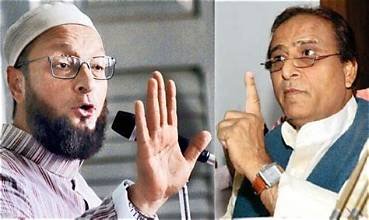
Azam Khan and Owaisi Face Off, Bringing a New Twist to Muslim Vote Politics!
Lucknow, November 28 (PMI – Special Report by Abbas Jafri): Political activity has intensified in Uttar Pradesh ahead of the 2027 Assembly elections. In particular, the verbal exchanges between senior Samajwadi Party leader Azam Khan and All India Majlis-e-Ittehadul Muslimeen (AIMIM) president Barrister Asaduddin Owaisi have revived the debate over Muslim political representation and electoral alliances among opposition parties. A key question emerging from this political confrontation is which party or alliance will retain the confidence of Muslim voters and whether the Congress can regain its lost political ground.
The issue is not merely a disagreement between two political leaders. It could also influence the electoral strategies of the Samajwadi Party, Congress, AIMIM, BJP and other political parties in Uttar Pradesh.
Why Have Differences Between Azam Khan and Owaisi Intensified?
In recent days, Asaduddin Owaisi, during his election speeches, has criticised the Samajwadi Party and Congress, arguing that Muslims should not be confined to voting for political parties and attending their rallies. Instead, he has called for greater participation in power and decision-making. His speeches have included the metaphor, “Abdul will no longer lay the carpets”, through which he has urged Muslims to reconsider their traditional political approach.
In response, Azam Khan questioned Owaisi’s political strategy. Speaking in a podcast on November 23, he asked why AIMIM was planning to contest all 403 Assembly constituencies in Uttar Pradesh when its political strength in Hyderabad was limited to a relatively small number of elected representatives. He also questioned the purpose of Owaisi’s entry into Uttar Pradesh politics. However, no independent evidence has emerged to substantiate the allegation implied in his remarks.
Azam Khan has also made sarcastic comments about Owaisi’s claims of political influence in Uttar Pradesh. Consequently, the differences between the two leaders have increasingly become linked to electoral politics and the question of Muslim political leadership and representation.
New Political Alliance Between Owaisi and Chandrashekhar Azad
Amid this political situation, on November 12, 2026, Asaduddin Owaisi and Nagina MP Chandrashekhar Azad announced an alliance under the banner of the Samajik Parivartan Morcha.
Both leaders expressed their intention to contest all 403 Assembly seats in the 2027 Uttar Pradesh elections, with Chandrashekhar Azad being projected as the alliance’s Chief Ministerial candidate.
The political strategy behind the alliance is to bring Muslim and Dalit communities onto a common platform. Muslims account for approximately 19–20 per cent of Uttar Pradesh’s population, while Scheduled Castes constitute around 21 per cent.
Thus, rather than limiting its appeal to Muslim voters, the alliance is seeking to attract Dalits and other disadvantaged communities as well.
However, announcing a political alliance and translating it into electoral success are two different matters. Its actual significance will depend on the extent to which the parties can secure public support beyond their traditional constituencies, select suitable candidates at the local level and communicate their electoral promises effectively.
Could the Political Confrontation Benefit the BJP?
Political observers have raised concerns that if the Samajwadi Party, Congress and the new alliance led by Owaisi field candidates against one another, opposition votes could be divided in certain constituencies.
In closely contested seats, even a relatively small shift in votes can influence the final electoral outcome.
However, it would be incorrect to assume that any division in Muslim votes would automatically benefit one particular party everywhere. The outcome would depend on local candidates, caste equations, Dalit voters’ preferences, organisational strength, the government’s performance and the nature of electoral alliances.
It is also worth noting that AIMIM fielded candidates in approximately 100 constituencies in the 2022 Assembly elections but failed to win a single seat. Therefore, the electoral strength of its new alliance in 2027 cannot be assessed solely on the basis of political rallies and public statements.
Can the Congress Regain Muslim Voters’ Support?
This is one of the most important questions, as the Congress is attempting to rebuild its political base in Uttar Pradesh.
However, previous election data indicate that independent Muslim support for the Congress and collective support for an opposition alliance should not be treated as the same thing.
According to figures from the CSDS-Lokniti post-poll survey, approximately 79 per cent of Muslim voters supported the Samajwadi Party-led alliance in the 2022 Uttar Pradesh Assembly elections, while the Congress received around 3 per cent of the Muslim vote.
This difference indicates that, at the time, a large section of Muslim voters viewed the Samajwadi Party as the principal opposition alternative to the BJP.
However, the political picture appeared different in the 2024 Lok Sabha elections. According to the CSDS-Lokniti post-poll survey, approximately 92 per cent of Muslim voters in Uttar Pradesh supported the INDIA alliance, which included both the Samajwadi Party and Congress.
Therefore, it would not be accurate to interpret this 92 per cent support as support for the Congress alone.
In the 2024 Lok Sabha elections, the Congress contested 17 seats in Uttar Pradesh as part of its alliance with the Samajwadi Party and won six. This indicated a revival in the Congress’s electoral fortunes, but the success came under a joint opposition alliance rather than through an independent electoral contest.
Thus, the main challenge before the Congress is not only to secure Muslim voters’ support but also to strengthen its organisational structure and local leadership.
Seat-Sharing Disagreement Between the Samajwadi Party and Congress
Another important issue is the distribution of Assembly seats between the Samajwadi Party and Congress.
According to reports that emerged towards the end of November, the Congress expressed its desire to contest approximately 120 seats, while the Samajwadi Party initially offered around 26 seats. This difference has made negotiations between the two parties more complicated.
However, speaking to the media on November 27, Azam Khan dismissed reports of differences within the Samajwadi Party-Congress alliance and asserted that the alliance would remain intact.
Therefore, it would be premature at this stage to interpret disagreements during seat-sharing negotiations as a sign of the alliance’s collapse.
Muslim Voters and Their Decisive Role: The Real Question
Muslim votes in Uttar Pradesh are not the permanent property of any single political party. Voters’ decisions in different regions are influenced by local issues, the popularity of candidates, education, employment, social security, development and political representation.
Similarly, the preferences of young voters, women, backward Muslim communities and people from different regions are not necessarily identical.
Azam Khan remains an important political face for the Samajwadi Party, while Asaduddin Owaisi advocates an independent political voice and representation for Muslims. His alliance with Chandrashekhar Azad seeks to connect this political approach with Dalit support.
On the other hand, the Congress is attempting to strike a balance between restoring its traditional support base and maintaining its political partnership with the Samajwadi Party.
The Final Decision Rests with the Voters
The verbal confrontation between Azam Khan and Asaduddin Owaisi has brought the issue of Muslim political leadership and representation in Uttar Pradesh back into the spotlight.
However, it is too early to draw any definitive conclusion about which political party will gain an electoral advantage from this confrontation.
The Congress has opportunities to regain Muslim support, but the 2024 figures should not be treated as evidence of its independent popularity, since a large section of Muslim voters supported the INDIA alliance as a whole.
Similarly, the new alliance between Owaisi and Azad cannot claim complete support from Muslim and Dalit voters merely on the basis of its announcement.
Ultimately, the 2027 Assembly elections will depend on which parties can win voters’ confidence through their approach to public issues, strong candidates, credible leadership and practical electoral programmes.
The decision of Muslim voters, too, will be shaped not merely by appeals from one leader or criticism from another, but by ground realities, regional political circumstances and their own interests. (pressmediaofindia.com)