 Pressmediaofindia
Related Articles



28-04-2026
Bureau Report + Agencies
NEW DELHI/ WASHINGTON: India and the United States are engaged in constructive talks aimed at reaching a balanced and mutually beneficial trade agreement, a foreign ministry spokesperson said on Thursday.
 The comments came after a three-day visit to Washington by an Indian trade delegation led by senior commerce ministry official Darpan Jain for talks with US counterparts.
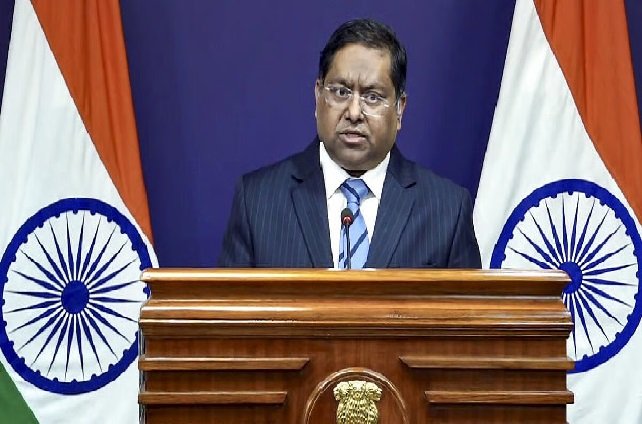
“These engagements are ongoing and constructive,” spokesperson Randhir Jaiswal told reporters at a weekly media briefing.
“Both sides are working towards a balanced, mutually beneficial and forward-looking trade agreement, taking into account each other’s concerns and priorities, and to achieve a trade target of $500 billion by 2030,” he said.
That target would be more than double the bilateral goods and services trade of about $212b in 2024.
The talks reflect a broader effort by New Delhi and Washington to clinch a trade pact, even as uncertainty over US tariff policy has complicated negotiations.
Earlier this week, Trade Minister Piyush Goyal said the two sides had nearly finalized the first tranche of a bilateral trade agreement and were working through the remaining details, including a mechanism to secure preferential market access for India in the US market relative to its competitors.
No concrete outcome emerged from the latest round of talks, but both sides will continue to engage, a government official said on the condition of anonymity, adding that the Indian delegation was expected to return to New Delhi by early Friday.
Efforts to frame an interim trade pact, including a proposal to lower US tariffs on Indian goods to about 18%, have been clouded by uncertainty following a US Supreme Court ruling, although negotiations are continuing.
Trade analysts and the opposition parties have questioned the government’s plans to sign a deal with Washington after President Donald Trump announced a temporary 10% duty on imports from all countries, including India.
 New Delhi is hoping to align any trade deal with Washington’s planned changes in June to the so-called Section 301 tariffs, which could reshape duties on key sectors and influence market access.
Meanwhile, Ankit Yadav, a seafarer from India, has been stuck on a boat at an inland Iranian port for about 2-1/2 weeks, surviving with his three fellow mariners on limited rations of tomatoes and potatoes. He is one among thousands of seafarers from India and other nations who are stranded in and around the Strait of Hormuz, as the war in Iran disrupts trade along one of the world’s busiest ship routes.
Ankit, who is in his early 30s, was on a small vessel carrying steel and plying between Iran, Kuwait and Oman. He said he could have left the conflict zone had the vessel received permission to sail to Oman and then be repatriated to India, but that could not happen because of the blockade imposed by the US Navy.
“The shipping company I work for is not ready to give us the sign-off because they do not want to pay higher air ticket prices and we cannot afford to buy them on our own. The only way out is the government’s help,” he told media by phone.
Salman Siddiqui, another Indian seafarer, is also at an Iranian port on a Comoros-flagged cargo vessel that was bound for Oman from Iran.
“The only thing we do here is plan how to spend the night and pray to God that we do not get hit during an attack,” Siddiqui said, speaking to Reuters from the vessel that is currently harbored at Khorramshahr.
“It is a kind of relief that a ceasefire is in place and we do not hear the same number of explosions like we used to see and hear earlier,” he told media by phone.