 Pressmediaofindia

Related Articles



02-05-2026
BEIRUT/ JERUSALEM: It is a spool of glass the width of a human hair, wound inside a 3D-printed housing that weighs less than a bag of sugar.
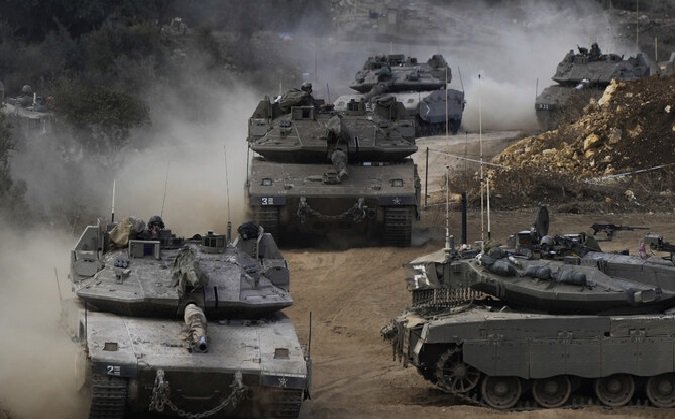 On 4 April, in southern Lebanon, it destroyed a Merkava Mk.4 main battle tank. The drone it trailed behind cost less than dinner for two in Tel Aviv. It arrived on no frequency. It crossed an airspace the occupation’s radar could not map.
It was guided by a pilot the occupation’s jammers could not silence. For two decades, the occupation state built an industry to stop a signal. Hezbollah sent a weapon thinner than the spider’s web that the late secretary-general Hassan Nasrallah once used to describe Israel’s fragility, a weapon that does not speak at all. In the first week of April, in southern Lebanon, a Namer heavy infantry fighting vehicle among the most heavily armored platforms the occupation army fields, mounting the 30mm Bushmaster cannon, a Spike missile launcher, and the Trophy active protection system designed to intercept incoming projectiles was struck by a $500 drone.
The drone carried a Soviet RPG warhead from 1961, unwound a hair-thin fiber-optic cable behind it as it flew, and approached a target whose entire defensive logic was built around a frequency the drone was not transmitting on. The War Zone reported the strike alongside confirmed hits on two Merkava Mk.4 tanks and a D9 bulldozer in the same window. Trophy, the system Rafael marketed as the answer to the next war, had met a weapon that does not emit.
An ambush years in the making
The occupation army’s 7th Brigade is not an ordinary armored unit. It fought at the Valley of Tears in 1973 and has served as Israel’s primary armored reserve on the northern front for half a century. On 25 March, its engineers sent a remotely operated D9 bulldozer north from Muhaysibat to probe the resistance’s defensive lines between Taybeh and Qantara. Hezbollah fighters watched the bulldozer pass through their fire arms and let it go. They were waiting for what came next.
 At 6:50 pm on Wednesday, 26 March, an armored column advanced in single file along the same route the decoy had taken. The resistance engaged the middle element first four Merkava Mk.4 tanks and a D9, destroyed in one coordinated salvo using Almas anti-tank guided missiles reverse-engineered from the occupation’s own Spike.
The rear platoon deployed smoke. Fire found it through the smoke. The lead element pushed toward Qantara’s fuel depot and was destroyed there. Inside two hours, 10 Merkava tanks and two D9 bulldozers lay burning.
The surviving soldiers abandoned their vehicles and walked out on foot. Military Watch Magazine described the incident as the heaviest Israeli armored losses in over 40 years. A doctrinal demonstration, using weapons Tel Aviv had long cataloged, jammed, and planned for.
The wire they cannot jam
A fiber-optic drone is a first-person-view quadcopter that trails a glass cable two to three tenths of a millimeter thick from a spool mounted between the frame and the payload. Control signals and live video travel down the fiber as pulses of light.
There is no radio transmission to hear. There is no electromagnetic emission to classify. There is no frequency on which the drone can be addressed and therefore no frequency on which it can be answered. The drone is, to every instrument in Rafael’s and Elbit’s counter-UAS catalog, a silence walking toward a target.
The absence is absolute. Systems like Drone Dome, built by Rafael, the same firm behind Iron Dome and Elbit’s ReDrone are designed to detect, classify, and disrupt radio signals. Israel Aerospace Industries’ Drone Guard operates on the same premise. (Int’l News Desk)