 Pressmediaofindia
Related Articles



17-03-2026
Bureau Report
NEW DELHI: As the United States-Israeli war on Iran completes two weeks, it has triggered a global energy crisis, even as Iran’s retaliation threatens to pull the rest of the Middle East into the conflict.
 The Strait of Hormuz, through which some 20 to 30 percent of global crude and liquefied natural gas (LNG) pass, has effectively been closed because of the conflict, sending crude prices soaring and disrupting oil and gas supplies.
From Southeast Asia to Pakistan, the ripple effects of the war are being felt across Asia and beyond but one country in particular could face a double whammy if the conflict intensifies: India, the world’s fourth-largest economy, depends on the Gulf for its energy needs and also for remittances sent by a vast workforce resident in the Middle East.
We unpack how the war is bleeding India’s economy.
Energy shortage
More than 80 percent of India’s gas and up to 60 percent of its oil pass through the Strait of Hormuz, which connects the Gulf to the Gulf of Oman and the Arabian Sea and is currently at the centre of retaliatory tactics Iran is deploying against the US and Israel. By threatening all shipping coming through, Iran has effectively closed the strait leaving Gulf oil producers with no sea route by which to deliver oil and LNG.
Most shipping insurers have cancelled war risk coverage for tankers in the strait. Then on Wednesday, a Thai ship heading to India was attacked, drawing criticism from India.
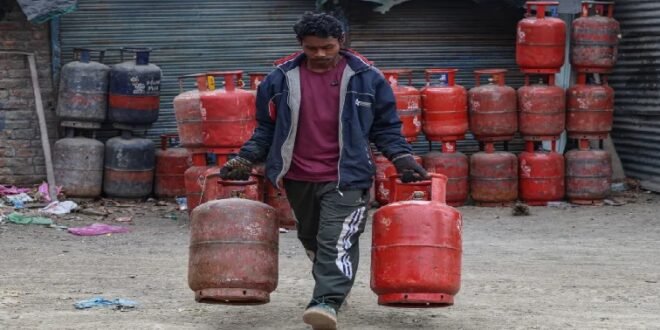
Hotels and restaurants in India are already weighing closure and people are queueing to stock up on LPG (cooking gas) cylinders amid fears of a shortage, even though the government assures the public it has approximately one month’s supply in storage. Such is the panic, however, that the government has gone as far as to invoke emergency measures to discourage hoarding, urging people to remain calm.
 Iran has invoked the right to self-defence to justify the retaliatory attacks and has used the strait as leverage in an attempt to end the war. More than 1,300 civilians have been killed and properties have been damaged across Iran amid the US-Israeli attacks.
Iran’s tactics seem to be working, as stocks have plunged and oil prices have spiked, reaching nearly $120 a barrel on Sunday before settling at about $100 this week, which is still about $40 more than before the war began. This week, Iran’s Islamic Revolutionary Guard Corps (IRGC) said it would not allow “one litre of oil” to pass the strait, and warned the world to expect oil to reach $200 per barrel.
The International Energy Agency’s (IEA) move on Wednesday to release a record 400 million barrels of crude oil has failed to stabilize oil prices.
Indian expats in the Gulf
India is also worried for some 9.1 million of its citizens who work in the Gulf Cooperation Council (GCC) countries, the United Arab Emirates, Saudi Arabia, Qatar, Oman, Kuwait and Bahrain. They send some $50bn in annual remittances back home.
If the war is prolonged, Pant says; “it will result in the loss of remittances … part of that also helps in balancing the trade balance”.
“It will hurt the wider economic robustness of the Indian economy. India’s hope of continuing to have a high rate of growth will suffer,” Pant said. “It’s not simply a question of energy security, it is also a question of economic security.”
Several Indian blue-collar workers and professionals across the Gulf have told Al Jazeera they fear potentially losing jobs if the war escalates further. Several oil and gas firms have shut operations amid the Iranian attacks.