 Pressmediaofindia

Related Articles



21-12-2025
Bureau Report
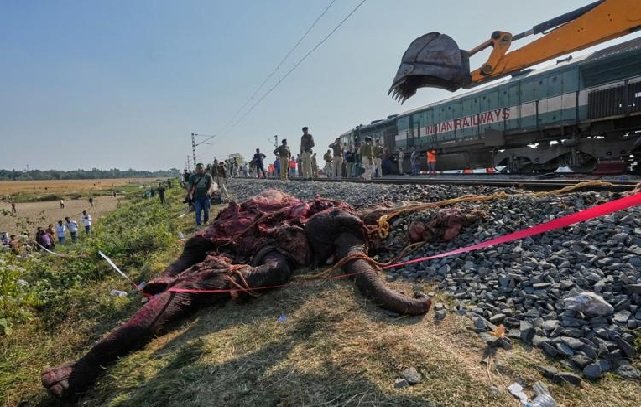
NEW DELHI/ GUWAHATI: A high-speed train carrying 650 people has collided with and killed seven wild Asiatic elephants and injured a calf in northern India.
 Five train coaches and the engine derailed following the impact, but there were no reported human casualties, Kishore Sharma, Indian Railways spokesman said.
Local authorities say the incident happened in the early hours of Saturday morning in India’s northeastern state of Assam.
Although the train driver spotted the hundred-strong herd crossing the track and used the train’s emergency brakes, some of the elephants were still hit.
Veterinarians carried out autopsies on the dead elephants which will be buried later in the day.
The Rajdhani Express train had been traveling from Mizoram state, which borders Myanmar, to the national capital of New Delhi.
The accident site is a forested area in Assam. Railway tracks in the state are often frequented by elephants, but Indian Railways said in a statement the accident location wasn’t a designated elephant corridor.
Despite the impact, passengers in the carriages which didn’t derail resumed their journey towards New Delhi.
Around 200 passengers who were in the five derailed coaches were moved to Guwahati in a different train.
Speeding trains hitting wild elephants is not rare in Assam, which is home to an estimated 7,000 wild Asiatic elephants, one of the highest concentrations of the pachyderm in India.
Since 2020, at least a dozen elephants have been killed by speeding trains across the state.
Wild elephants often stray into human habitations this time of year, when rice fields are ready for harvesting.
 Meanwhile, African elephants have names for each other that are spoken through rumbles, scientists have found, in a “really exciting” discovery.
It’s the first time an animal has been discovered creating individual names for each other, instead of just mimicking the other’s noises like parrots and dolphins do.
“It’s really exciting,” said Dr Joyce Poole, scientific director of ElephantVoices, who was part of the team that made the discovery that was published in the Nature Ecology & Evolution journal.
“Elephants live in a pretty complex society. They’re quite a bit like ourselves (in that) families are not together all the time, they split up and come back together,” she told media.
By giving each other names, family members can call each other back to the herd or from across vast distances when they need to communicate.
‘Sandy!’ rumbles Shirley the elephant
An elephant nicknamed ‘Shirley’ calls ‘Sandy’ in an audio recording sent to media by the researchers. Far from the trumpeting noise we often associate with elephants, the researchers say Sandy’s name is a deep, reverberating rumble that lasts for around six seconds.
In another, ‘Echo’ calls for another elephant, nicknamed Ella. Ella’s name is lower in tone than Sandy’s and comes to a long, slow close, whereas Sandy’s drops in tone and volume and then lingers.
The scientists used artificial intelligence to analyze recordings of elephants collected by Dr Poole and her colleagues since 1986 in Amboseli National Park and Samburu National Reserve in Kenya.