 Pressmediaofindia
Related Articles

Jammu/Kashmir March 1 (PMI) Widespread protests erupted across parts of Jammu and Kashmir on March 1 after Iranian state media confirmed that Supreme Leader Ali Khamenei was killed in joint airstrikes carried out by Israel and the United States.
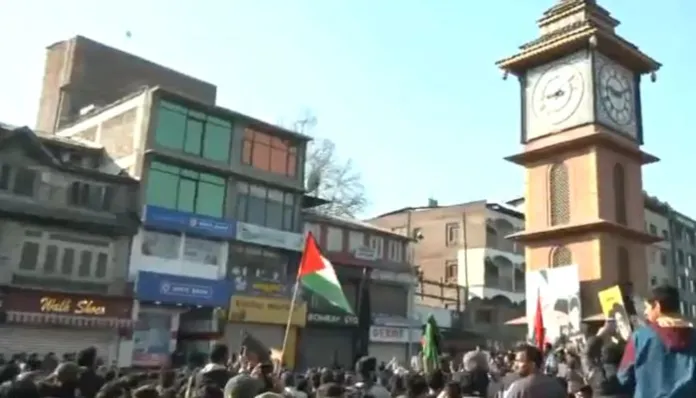
Demonstrations were reported from Srinagar, Sonawari, and Bandipora, where hundreds of protesters gathered, raising slogans and expressing anger over the reported attack. Many Kashmiri Shia Muslims were seen carrying portraits of Khamenei, waving black flags, and chanting traditional mourning hymns (Nauha).
A protester told PMI that the community was deeply saddened by the news, describing Khamenei as more than a foreign political leader and referring to him as a Marja-e-Taqlid (Source of Emulation) for the Shia Muslim community.
Political Reactions
Former Chief Minister and president of the People’s Democratic Party, Mehbooba Mufti, strongly condemned the strikes. She described the attack as an act of aggression and called Iran a defining voice of the Muslim world. Mufti also expressed disappointment over what she termed the silence and implicit support of several Muslim nations.
“What’s more disgraceful and shocking is the explicit and implicit support given by Muslim countries who chose convenience and expedience over conscience,” she said, adding that history would judge those who stood for justice and those who sided with oppressors.
Kashmir’s chief cleric, Mirwaiz Umar Farooq, termed the strike a dangerous escalation and alleged that the absence of international accountability had emboldened Israel.
Iran Announces 40 Days of Mourning
Iranian state television confirmed Khamenei’s death hours after US President Donald Trump announced the killing of the 86-year-old cleric. Tehran subsequently declared 40 days of national mourning.
Iran’s National Security Council warned of a major uprising in response to the strikes, signalling further escalation in an already volatile regional situation.
Khamenei’s Legacy
Khamenei assumed leadership in 1989 after the death of Ruhollah Khomeini, the architect of the 1979 Islamic Revolution that overthrew Shah Mohammad Reza Pahlavi. Initially perceived as a relatively low-ranking and bureaucratic cleric, Khamenei went on to become the Islamic Republic’s longest-serving ruler.
Over more than three decades, he consolidated clerical authority and strengthened the role of the Islamic Revolutionary Guard Corps (IRGC), transforming it into Iran’s most powerful military and economic force. Through a network of appointed institutions capable of overriding elected bodies, he emerged as the ultimate decision-maker in Iran’s political system.
His reported death comes amid extraordinary regional tensions following months of escalating hostilities between Iran, Israel, and the United States. (pressmediaofindia.com)