 Pressmediaofindia
Related Articles

24-02-2026
Bureau Report
NEW DELHI: India moved to deepen trade ties with Brazil on Saturday, signing a pact to expand cooperation in mining and minerals as it seeks to meet rising domestic steel demand and support capacity expansion amid a global race for raw materials.
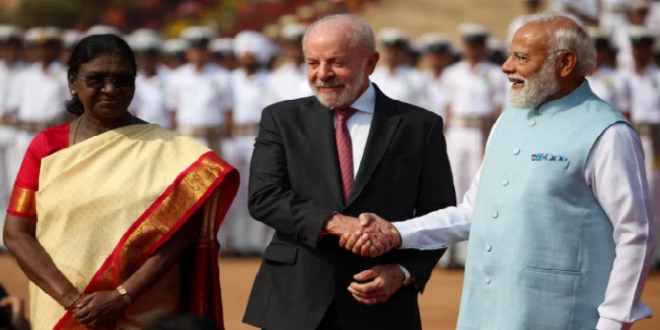
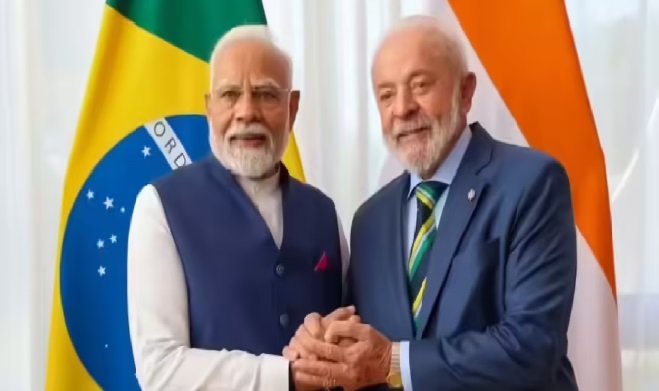 The agreement was signed in the presence of India’s Prime Minister Narendra Modi and Brazilian President Luiz Inacio Lula da Silva, who arrived in New Delhi earlier this week for a three-day visit. Brazil is among the world’s top producers of iron ore and holds large reserves of minerals critical to steelmaking. Closer cooperation is expected to improve India’s access to raw materials and technologies needed to sustain long-term growth in its steel sector, an Indian government statement said.
The cooperation will focus on attracting investment in exploration, mining and steel sector infrastructure, the statement said.
India has steelmaking capacity of 218 million metric tons, and companies are expanding output to meet rising domestic demand driven by infrastructure development and industrialization.
Addressing a meeting with a Brazilian delegation led by Lula, Modi said their talks had focused on ways to deepen the India-Brazil trade partnership.
“We are committed to taking bilateral trade much beyond $20 billion in the next five years,” Modi said.
Bilateral trade between the two countries currently stands at about $15 billion.
“Our nations will also work closely in areas such as technology, innovation, digital public infrastructure, AI, semiconductors and more,” Modi said.
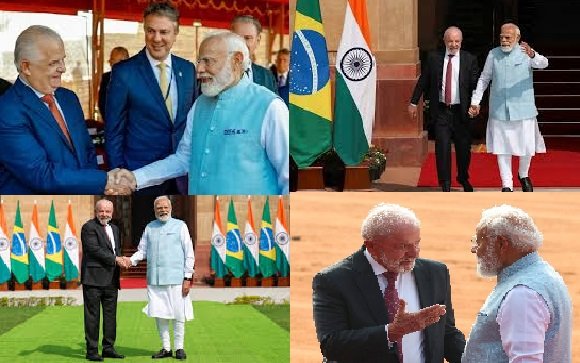 India and Brazil have been strategic partners since 2006, with cooperation spanning trade, defence, energy, agriculture, health, critical minerals, technology and digital infrastructure.
Brazil is India’s largest trading partner in the Latin America and Caribbean region, and the two countries work closely on global issues such as UN reform, climate change and counter-terrorism.
Lula on Thursday advocated for Brazil and India to conduct trade in their own currencies rather than settling transactions in US dollars, but dismissed speculation that the BRICS group of countries, of which both nations are members, would create a common currency.
For many years, India successfully leveraged US tensions with China and Russia to its advantage, playing both ends against the middle. On one side, New Delhi spotlighted its potential as a counterweight to China and on the other, it reaffirmed its allegiance to Chinese and Russian-led geopolitical blocs, BRICS and SCO, which America believes pointedly challenge its global leadership by pursuing to construct an alternative international order and upend US dollar dominance.
Employing Machiavellian diplomatic maneuvering and lofty claims, India framed itself as a prized American partner whose indispensability was central to implement US Indo-Pacific strategy. Tactics worked as Trump, in his first term, pitched India as a vital ally in the Indo-Pacific to set off a new cold war with China. His successor Joe Biden, after initially pressing India to cut back its oil purchases from Moscow over its invasion of Kyiv, too inveigled it to advance shared interests in the region.
India’s archetypal practice of changing goalposts when it suits its interests, what New Delhi calls a non-aligned policy, drove it to circumvent rifts with China, swindle the West and boost trade with Russia. Its trade with Moscow last year topped $68 billion, about six times the pre-pandemic levels. Shockingly, India’s imports from Russia accounted for almost 93% of bilateral trade including $50.3 billion spent on buying Russian discounted crude.