 Pressmediaofindia
Related Articles



25-01-2026
DAVOS, SWITZERLAND: Europe may have rallied to see off President Donald Trump over Greenland, but its leaders recognize the confrontation is unlikely to be the last in dealings with his increasingly strident version of the United States.
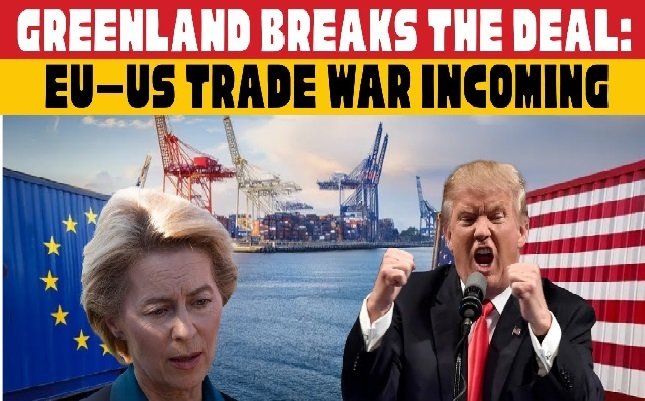 The stakes could hardly be higher, given the $2 trillion trading relationship between the European Union and the US and the dominant role Washington continues to play in the NATO alliance and in support of Ukraine against Russia.
This week, in the space of a few hours at the World Economic Forum’s annual meeting in Davos, Trump first ruled out taking Greenland by force and then removed the threat of new tariffs on eight European states standing in his way, hailing instead a vague deal for the Arctic island with NATO chief Mark Rutte.
European leaders believe Trump backed down in part because in contrast to their more accommodating stance in last year’s tariff negotiations, this time they made it clear he was crossing a red line by asserting that Greenland’s status as an autonomous territory of Denmark was non-negotiable.
“All this shows that you cannot let the Americans trample all over the Europeans,” said a European Union official, who requested anonymity to speak candidly about US ties.
“We did the right thing to push back, to be firm in what we said, but it is not over. My sense is that we will be tested constantly on issues like this,” the official told media.
While Europe may have learned the value of standing up to Trump, the challenge is ensuring it is less exposed next time.
“It’s a hard route, and it’s going to take time,” said Rosa Balfour, director at Carnegie Europe, adding that Europe had “far more leverage than it has dared to use”.
An emergency summit of Europe’s leaders on Thursday called for last year’s EU-U.S. trade deal to be put back on track after lawmakers suspended its ratification in protest over Greenland.
 “Despite all the frustration and anger of recent months, let us not be too quick to write off the transatlantic partnership,” German Chancellor Friedrich Merz said in Davos beforehand.
While seeking to stabilize the partnership, Europe is also taking steps aimed at “de-risking” it given the open antipathy from Trump, whose new national security strategy accuses the continent of freeloading on defence and demands it open its markets to US companies. Europe is only too aware of how long it can take to get agreement among 27 nations with different histories, politics and economies, which was highlighted in taunts this week by US Treasury Secretary Scott Bessent.
Two EU officials said the Greenland row has accelerated discussions on how the approach taken on Ukraine in which countries offer security guarantees on a voluntary basis and no one has a right of veto can be extended.
“We should do more with coalitions of the willing and leave it open for others to follow if they want,” said one, adding that joint efforts to boost Europe’s development of artificial intelligence technology could be one example.
Coalitions such as the “E3” group comprising France, Germany and Britain focusing on security matters also allow non-EU states to take part, which speaks to others on the rough end of Trump policies.
“The middle powers must act together, because if we’re not at the table, we’re on the menu,” Canadian Prime Minister Mark Carney said in a Davos speech to warm applause. Another route is using the leeway afforded by EU law.
In December, EU states used an emergency provision to indefinitely immobilize hundreds of billions of dollars of Russian assets. That removed the risk of a pro-Moscow country like Hungary blocking the roll-over of the measure at some point and forcing the EU to return the money. (Int’l News Desk)