 Pressmediaofindia
Related Articles


21-02-2026
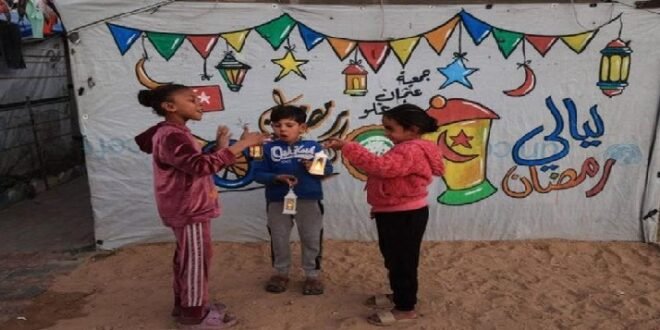
GAZA STRIP: At the Bureij refugee area in central Gaza, Maisoon al-Barbarawi welcomes the Islamic holy month of Ramadan in her tent.
 Simple decorations hang from its worn ceiling, alongside colorful drawings on the fabric walls, prepared by camp residents to mark the arrival of the blessed month.
“We brought you decorations and a small lantern,” Maisoon tells her nine-year-old son, Hasan, smiling with an exhaustion tinged with joy at her ability to buy him a Ramadan lantern.
“My means are limited, but what matters is that the children feel happy,” Maisoon tells media expressing cautious optimism about the month’s arrival.
“I wanted these decorations to be a way out of the atmosphere of grief and sadness that has accompanied us over the past two years during the war.”
Maisoon, known to everyone as Umm Mohammed, is 52 years old and a mother of two children.
“My older son is 15, and the younger is nine years. They are the most precious things I have.”
“Every day they are safe is a day worth gratitude and joy,” she says with pride mixed with fear, referring to the terror that has accompanied her throughout the war at the thought of losing them.
Like other Palestinians in Gaza, what distinguishes this Ramadan is the relative calm that has come with the current ceasefire, compared with the previous two years, when Israel’s genocidal war on Gaza, which has killed more than 70,000 Palestinians, was at its peak.
“The situation is not completely calm,” Maisoon explains. Everyone knows the war hasn’t truly stopped; shelling still happens from time to time but compared to the height of the war, things are less intense.”
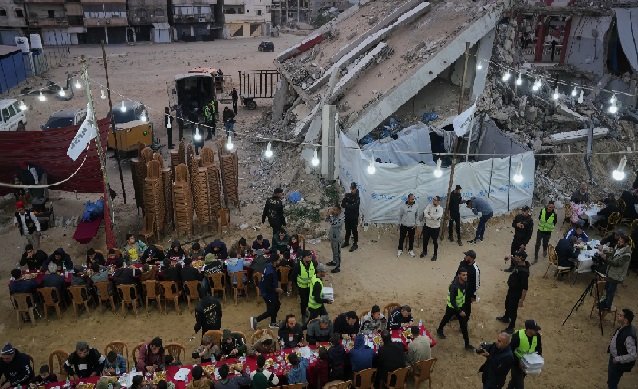
 Maisoon participates in camp administration activities, helping prepare bread and arrange dates and water for distribution, minutes before the call to prayer on the first day of Ramadan.
“This is the third Ramadan we’ve spent in displacement. We lost our homes, our families, and many loved ones” but “here in the camp, we have neighbors and friends who share the same pain and suffering, and we all want to support one another socially.”
Maisoon lost her home in southeastern Gaza at the beginning of the war and was forced to flee with her husband, Hassouna, and their children, moving between camps before eventually settling in Bureij under what she describes as “very bad conditions”.
“We are trying to create life and joy out of nothing. Ramadan and Eid come and go, but our situation remains the same,” she says after a brief pause.
‘Wounded from within’
Maisoon’s words fluctuate between optimism and fear, but she insists that Ramadan is “a blessing”, despite everything around her.
On the first day of Ramadan, she had not yet decided what she would cook for her family, as her limited means would only allow for a modest meal but she had already prepared her prayers and wishes before breaking her fast.
“I will pray that the war never returns. That is my daily prayer: that things calm down completely and that the army withdraw from our land,” she says, pointing to bullet holes in her tent caused by gunfire from an Israeli quadcopter drone days earlier.
Fear of the war’s return during Ramadan is not unique to Maisoon, but is shared by many across the Gaza Strip, who worry about a renewed escalation, similar to last year when fighting resumed on March 19, 2025, coinciding with the second week of Ramadan. (Int’l Monitoring Desk)