 Pressmediaofindia

Related Articles



19-03-2026
Bureau Report
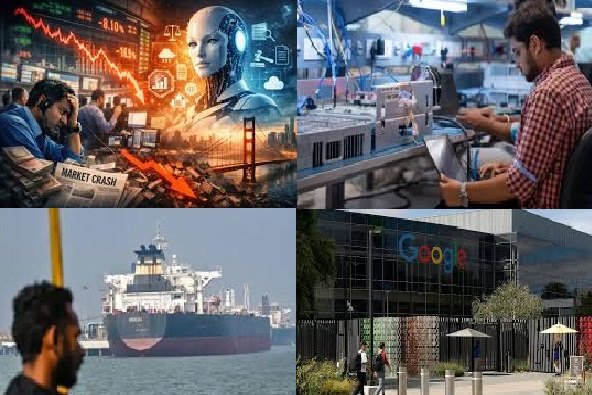
NEW DELHI: Indian technology stocks have seen an unprecedented rout over the past few weeks over fears of artificial intelligence upending the traditional outsourcing model that powers the country’s $300bn (£223bn) back-office industry.
 The sell-off, part of a global correction in traditional software and IT stocks, preceded the market nervousness caused by recent geopolitical uncertainty, and is particularly significant for India.
Over the past three-and-a-half decades, India’s software industry has created millions of white-collar jobs, spawning a new middle class driven by high ambition and strong purchasing power. This, in turn, has fueled demand for apartments, cars and restaurants across top-tier cities such as Bengaluru, Hyderabad and Gurugram over the past 30 years.
The Nifty IT index of 10 of the country’s biggest software companies is down some 20% this year, wiping out tens of billions of dollars in investor money.
The sell-off began early in February after Anthropic’s Claude agent released a new tool that it claimed could automate key legal, compliance and data processes, hitting at the heart of the labor-heavy industry’s business model.
The panic has intensified thereafter as more founders raised the alarm about IT services disappearing by 2030. Some CEOs have even warned that AI could eliminate 50% of entry-level white-collar jobs. Amid the unease, Indian IT giants have sought to calm frayed nerves, saying the fears are overblown. Artificial intelligence will create new opportunities, they say, though there’s little doubt it will structurally change how things were done in the past.
“The nature of client engagements is likely to structurally shift towards advisory and implementation, with application managed services (22-45% of revenues) seeing sharp revenue deflation,” global investment banking giant Jefferies said in a note.
 Simply put, that means the fees that Indian IT companies earned from clients like banks or oil companies to run and maintain software, fix bugs and handle updates will shrink as the focus shifts to more high-value but less regular tasks such as consulting. This will fundamentally impact revenue growth and demand for workers according to Jefferies, which predicts the worst-case scenario for IT companies to be 3% lower revenue growth over the next five years, followed by no growth at all, beyond 2031 but not all views are negative.
JPMorgan Chase, which calls IT firms the “plumbers of the tech world”, says while AI will accelerate complex tasks and write more software code, it is “simplistic to assume” that they can offer the same level of customization as software companies.
Rather than one replacing the other, it foresees more partnerships between “AI tool firms and IT services firms that can create several new areas of work”.
Salil Parekh, CEO of India’s second largest IT major Infosys, has supported this narrative, saying AI expands the opportunities for firms like his, as they are best poised to help clients modernize legacy systems by deploying intelligent tools.
According to Infosys, generative AI might displace 92 million jobs such as front-end developers and testers, but it will create some 170 million new jobs for data annotators, AI engineers and AI leads.
Software companies will be the “primary mechanism for the diffusion of AI across the world’s largest enterprises”, HSBC said in a recent report titled Software Will Eat AI, arguing that IT services companies will actually drive AI adoption across organizations.
Large-scale AI systems, it says, are “inherently flawed”, and not suited to do a “lift and replacement” of major software platforms used by enterprises, even though they may be appropriate for things like image creation programs.