 Pressmediaofindia
Related Articles

03-01-2026
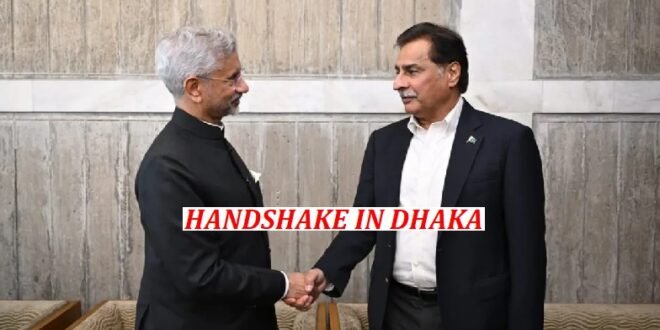
DHAKA/ NEW DELHI/ ISLAMABAD: On December 31, the final day of 2025, India’s Foreign Minister Subrahmanyam Jaishankar did what India’s men, women’s and Under-19 cricket teams had only recently refused to do.
 He shook hands with a Pakistani representative in public.
Jaishankar and Ayaz Sadiq, the speaker of Pakistan’s National Assembly, were among a gathering of regional leaders that had descended in Dhaka earlier this week to attend former Bangladesh Prime Minister Khaleda Zia’s funeral ceremony.
With Sadiq present in a waiting room at Bangladesh’s parliament in Dhaka, Jaishankar walked over and shook his hand in the presence of diplomats from several South Asian countries.
“He walked up to me and said hello, at which I stood up, and he introduced himself and shook hands with a smile. As I was about to introduce myself, he said, ‘Excellency, I recognize who you are and no need to introduce yourself’,” Sadiq, a veteran politician from Pakistan’s ruling Pakistan Muslim League-Nawaz (PMLN), recounted the interaction to a private news channel on Wednesday night.
Once Jaishankar entered the room, Sadiq said, the Indian minister first met delegations from Nepal, Bhutan and the Maldives before approaching him.
“He knew what he was doing. He realized the presence of other people in the room, but he had a smile on his face, and he was well aware,” the Pakistani politician added.
Images of the handshake were shared by Sadiq’s office and were also posted on social media account of Muhammad Yunus, chief adviser of Bangladesh’s interim government.
This was in stark contrast from September, when the Indian men’s cricket team captain Suryakumar Yadav and his players refused to shake hands with their Pakistani counterparts during an Asia Cup clash last year. The tournament, played in the United Arab Emirates and won by India after beating Pakistan in a thrilling final, underscored how deeply resentful relations between the two neighbors had become.
 A bitter four-day aerial conflict in May, in which both nuclear-armed countries declared themselves victorious, marked the latest and most serious chapter in an antagonism that stretches back to their violent partition from British rule in 1947.
As the fighting spilled over into sport, it reinforced how political tensions had seeped into nearly every public interaction when it comes to these two nations until Jaishankar’s handshake on Wednesday.
While some Indian commentators viewed the interaction negatively, voices in Pakistan saw it as a possible signal of a modest thaw in an otherwise icy relationship.
“I think that the interaction between Jaishankar and Ayaz Sadiq is a welcome development for the New Year,” Mustafa Hyder Sayed, an Islamabad-based foreign policy analyst, told media.
“I think basic normalcy of relations in which respect is accorded to officials and hands are shaken, it is the bare minimum which unfortunately was absent after the war between India and Pakistan,” he said.
Rivalry hardens
Relations between the nuclear-armed neighbors have deteriorated for years and plunged further this April after an attack in Pahalgam in Indian-administered Kashmir, when gunmen killed 26 civilians.
India blamed Pakistan for the killings and, among other measures, withdrew from the six-decade-old Indus Waters Treaty (IWT), which governs the use of six rivers in the Indus basin, which the neighbors share. (Int’l Monitoring Desk)