 Pressmediaofindia
Related Articles


15-01-2026
Bureau Report
NEW DELHI/ WASHINGTON: Hate speech against minorities including Muslims and Christians in India rose by 13% in 2025, with most incidents occurring in states governed by Prime Minister Narendra Modi’s Hindu nationalist Bharatiya Janata Party, a Washington-based research group said on Tuesday.
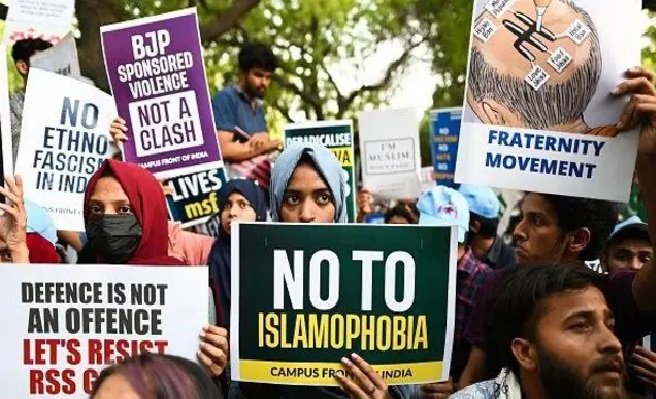 India Hate Lab documented 1,318 instances of what it called hate speech in 2025, up from 1,165 in 2024 and 668 in 2023, at events such as political rallies, religious processions, protest marches and cultural gatherings.
Of that number, 1,164 incidents occurred in states and union territories governed by the BJP, either directly or with coalition political parties, the group said.
The Indian embassy in Washington did not respond immediately to a request for comment. Modi and his party deny being discriminatory and say their policies, including food subsidy programs and electrification drives, benefit all communities.
April recorded the highest monthly spike, 158 events, with nearly 100 occurring between April 22, after a deadly Islamist militant attack in India-administered Kashmir, and May 7, when four days of deadly fighting broke out between India and Pakistan. Rights groups including Amnesty International and Human Rights Watch say abuse of minorities has risen in India since Modi took office in 2014, pointing to a religion-based citizenship law the UN calls “fundamentally discriminatory,” anti-conversion legislation that challenges freedom of belief, the 2019 removal of Muslim-majority Kashmir’s special status, and the demolition of Muslim-owned properties.
India Hate Lab, founded by US-based Kashmiri journalist Raqib Hameed Naik, is a project of the Center for the Study of Organized Hate, a nonprofit Washington-based think tank. The BJP has previously said India Hate Lab presents a biased picture of India.
India Hate Lab says it uses the UN’s definition of hate speech, which defines it as prejudiced or discriminatory language towards an individual or group based on attributes including religion, ethnicity, nationality, race or gender.
 Last year, the US government and the United Nations on Tuesday expressed concerns about a contentious religion-based citizenship law, opens new tab in India, with the UN calling the legislation “fundamentally discriminatory in nature.”
Rights advocates have criticized the 2019 Citizenship Amendment Act, which the Indian government moved to implement, opens new tab on Monday. Human Rights Watch and Amnesty International say it discriminates against Muslims.
Media provides all the news you need to start your day. Sign up here. Just weeks before Indian elections, Prime Minister Narendra Modi’s Hindu nationalist Bharatiya Janata Party government has been pushing to implement the law, which makes it easier to get Indian citizenship for non-Muslim refugees from three Muslim-majority South Asian nations: Afghanistan, Pakistan and Bangladesh.
Rights groups’ note the law leaves out, opens new tab Muslim minority groups like Shia Muslims from those countries while also excluding neighboring countries where Muslims are a minority, like the Rohingyas in Myanmar.
“As we said in 2019, we are concerned that India’s Citizenship (Amendment) Act 2019 (CAA) is fundamentally discriminatory in nature and in breach of India’s international human rights obligations,” a spokesperson of the Office of the United Nations High Commissioner for Human Rights said.
He added the office was studying whether the law’s implementation rules comply with international human rights law. “We are concerned about the notification of the Citizenship Amendment Act on March 11. We are closely monitoring how this act will be implemented.