 Pressmediaofindia
Related Articles


01-04-2026
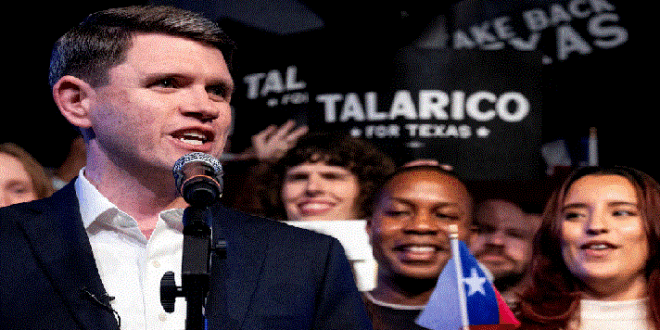
NEW YORK: As the video opens, Democratic Texas State Representative James Talarico appears to stand in front of a Texas flag, beaming.
 “Radicalized white men are the greatest domestic terrorist threat in our country,” the US Senate candidate seems to say into the camera. As a voice whispers “white men,” Talarico continues: “So true. So true” but Talarico never filmed that video. Instead, the clip is an AI-generated ad from the National Republican Senatorial Committee (NRSC), the party’s Senate campaign arm, featuring a computer-altered Talarico reciting social media posts he wrote years ago. The words “AI generated” show up in easy-to-miss font in the lower right-hand corner.
The realistic video is among a vanguard of “deepfake” advertisements that some campaigns are already deploying ahead of November’s midterm elections, taking advantage of AI tools that are improving at a breakneck pace.
The ads are being introduced into a media landscape with few guardrails. There is no federal regulation constraining the use of AI in political messaging, leaving only a patchwork of largely untested state laws and while social media companies like Meta and X label certain AI-generated content, they have scrapped professional fact‑checking systems in favor of user-generated notes.
Politics experts worry such videos could leave voters confused, or even deceived. The stakes are high; the election will determine which party controls Congress for the final two years of Republican President Donald Trump’s term, with Democrats seemingly well positioned to capture a majority in the US House of Representatives but facing longer odds in the US Senate.
The ads appear to be effective, political strategists and experts said. One 2025 study, published in the peer-reviewed Journal of Creative Communications, found that people struggle to identify deepfake videos and that their opinions are affected by this type of misinformation.
So far, Republicans appear to be utilizing the technology more frequently than Democrats this election cycle, according to politics experts and a media review of publicly available ads.
 The Republicans are following the lead of Trump’s White House, which has released scores of AI-generated videos and gaming-inspired memes on social media that do everything from disparaging protesters to hyping up the Iran war.
The Talarico ad, for instance, is one of three recent ads created by national Republicans that use deepfake technology realistic yet fabricated videos made by AI algorithms that have become increasingly easy to create.
NRSC Communications Director Joanna Rodriguez defended the ad in a statement to Reuters, saying Democrats were “panicking after seeing and hearing James Talarico’s own words.”
JT Ennis, a spokesperson for Talarico’s campaign, said that while his opponents “spend their time making deepfake videos to mislead Texans, we are uniting the people of Texas to win in November.”
Among Democrats, the most notable user of AI-generated videos is California Governor Gavin Newsom, a potential 2028 presidential candidate who has frequently employed deepfake videos to troll Trump. But the Democratic Party’s national campaign committees have not yet sought to mirror the NRSC’s efforts in midterm campaigns.
The campaign of Republican US Representative Mike Collins of Georgia, who is vying to challenge Democratic Senator Jon Ossoff in November, created a deepfake video in which Ossoff appears to say: “I just voted to keep the government shut down. They say it would hurt farmers, but I wouldn’t know. I’ve only seen a farm on Instagram.” (Int’l News Desk)